How it works
Simple. Collaborative.
Built for real impact
SecBrains takes a practical, collaborative approach to help you understand your cybersecurity risk and build a stronger, more resilient organization.
NIST-BASED. AI-ENHANCED. HUMAN-CONTROLLED
1
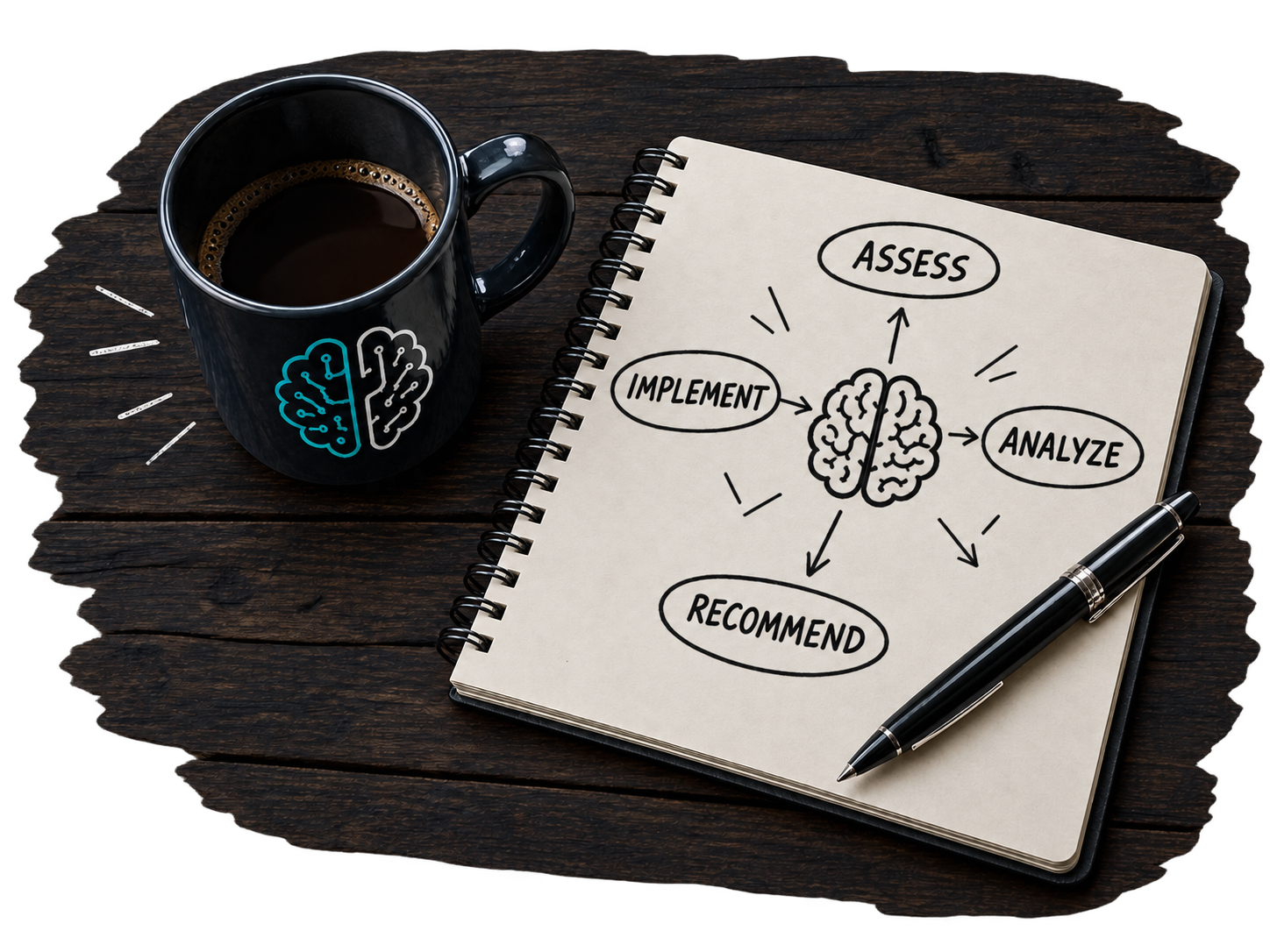
Discovery
We learn about your business, your goals, and the challenges you face.
2
Assessment
We assess your security controls and AI governance to understand your current state.
3
Analysis
We analyze the findings, identify gaps and risks, and provide clear, actionable insights.
4
Action
We deliver practical recommendations and roadmaps to strengthen your posture and reduce risk.
What you Receive.
Every engagement with SecBrains includes the following deliverables.
Assessment report
A clear, prioritized summary of your current state, key findings and gaps against leading frameworks.

Risk Heat Map
A visual overview of your highest-risk areas, so you can focus where it matters most.
Actionable Roadmap
Practical, prioritized recommendations and a roadmap to close gaps and reduce risk.

Executive Summary
A concise, board-ready summary of key risks and next steps for leadership.

Optional Raw Data
Access to the data and evidence behind the findings for deeper review.
Always included.

Experienced cybersecurity professionals
Objective, framework-based approach
Confidential and independent analysis
Built for your business, not a template
Ongoing support to drive meaningful improvement
See how we help clients
Cyber Risk Assessment Explained

AI Governance workshop overview

Shadow AI, the hidden risk

Let's start a conversation about your next steps.
CLARITY. PRIORITIES. PROGRESS
Know where you stand — and what should happen next
A practical, management-focused assessment that turns cybersecurity controls, maturity, and operational reality into clearer priorities for leadership.
Most organizations already have security controls, technologies, policies, suppliers, and improvement initiatives in place. The harder question is whether those controls are consistently implemented, appropriately governed, and addressing the risks that matter most to the business.
SecBrains brings experienced facilitators together with your IT, security, and business stakeholders to work through that question. Our approach uses the NIST Cybersecurity Framework and CIS Controls as complementary lenses, supported by curated validation questions and operational discussion.
This is not a technical audit and it is not another generic checklist. The objective is to understand the organization’s current control maturity, challenge important assumptions, identify meaningful gaps, and turn the findings into practical management action.
What we look at
- Cybersecurity control maturity and implementation
- Governance, ownership, and accountability
- Operational assurance and important control assumptions
- Credible cybersecurity risk scenarios
- Where improvement effort will have the greatest value
What you receive
- An executive view of cybersecurity maturity
- Prioritized risk and control observations
- Top improvement priorities
- A practical improvement roadmap
- Detailed NIST CSF and control-domain analysis
- Clearer linkage between cybersecurity activity and business risk
Put practical guardrails around AI — without stopping adoption
Understand how AI is actually being used, where the important governance gaps exist, and what practical controls should come next.
AI adoption rarely waits for a complete governance program. Employees experiment with new tools, business teams find useful applications, vendors introduce AI capabilities, and sensitive information can begin moving through services that were never formally reviewed.
The challenge is not simply whether AI should be used. It is establishing enough visibility, ownership, and practical guidance that the organization can use AI confidently without creating unnecessary risk.
SecBrains facilitates a structured discussion across technology, security, privacy, governance, and business stakeholders. We help uncover where AI is already being used, identify areas of uncertainty, and establish realistic guardrails that support responsible adoption rather than simply producing another policy document.
What we look at
- Current and emerging AI use across the organization
- Ownership, accountability, and decision authority
- Acceptable use and employee guidance
- Shadow AI and unapproved tools
- Data handling, privacy, and information exposure
- Third-party and embedded AI capabilities
- Oversight, review, and ongoing governance
What you receive
- A clear view of current AI governance posture
- Priority governance and risk gaps
- Practical recommendations for responsible adoption
- Defined areas of ownership and accountability
- Guidance for acceptable use and data handling
- A practical roadmap for strengthening AI governance
Strong security controls. Less clarity about what should come next.
This higher-education organization had invested in solid cybersecurity capabilities. The challenge was understanding how those controls came together, where meaningful gaps remained, and which issues deserved leadership attention first.
The situation
The institution operated in a heavily cloud- and SaaS-dependent environment supporting learning, administrative, financial, and student-facing services.
Operational security was stronger than the overall maturity score might initially suggest. Multi-factor authentication was enforced across the user population, endpoint detection and response coverage exceeded 95%, 24×7 managed detection and response was in place, and backups were immutable and logically separated.
What was less mature was the governance wrapped around those capabilities. Executive accountability, enterprise risk integration, access governance, third-party oversight, and coordinated recovery planning were not yet consistently institutionalized.
What SecBrains did
SecBrains facilitated three structured workshops using the NIST Cybersecurity Framework 2.0 together with an operational control lens. Governance and cybersecurity maturity were examined alongside the way controls actually operated day to day.
Rather than producing another undifferentiated list of findings, the assessment connected maturity, operational reality, institutional dependencies, and business consequences.
What became clear
- Overall cybersecurity maturity was assessed at 2.4 out of 5, with a Defined maturity level of 3 identified as the next practical target.
- Operational safeguards were comparatively strong, while governance and incident-response maturity lagged behind.
- Identity represented a critical security boundary because of the institution's extensive reliance on SaaS and federated access.
- Third-party and SaaS dependencies required stronger lifecycle governance and recovery assurance.
- Technical recovery capabilities existed, but coordinated business recovery expectations, sequencing, and decision authority needed greater structure.
The priorities
The assessment distilled the findings into five leadership priorities:
- Establish executive cybersecurity accountability and oversight.
- Build a formal workforce security awareness and readiness program.
- Implement role-based access and privilege governance.
- Integrate cybersecurity risk into enterprise risk management.
- Establish third-party risk governance and ongoing monitoring.
From findings to action
Those priorities were translated into a sequenced roadmap beginning with governance and decision authority, then reducing identity, SaaS, and supplier exposure, and finally strengthening monitoring, response, and recovery assurance.
SecBrains helped us cut through the noise, align our leadership team, and focus on the issues that actually move the needle. IT Manager, Higher Education SectorDISCUSS A CONTROLS ASSESSMENT →